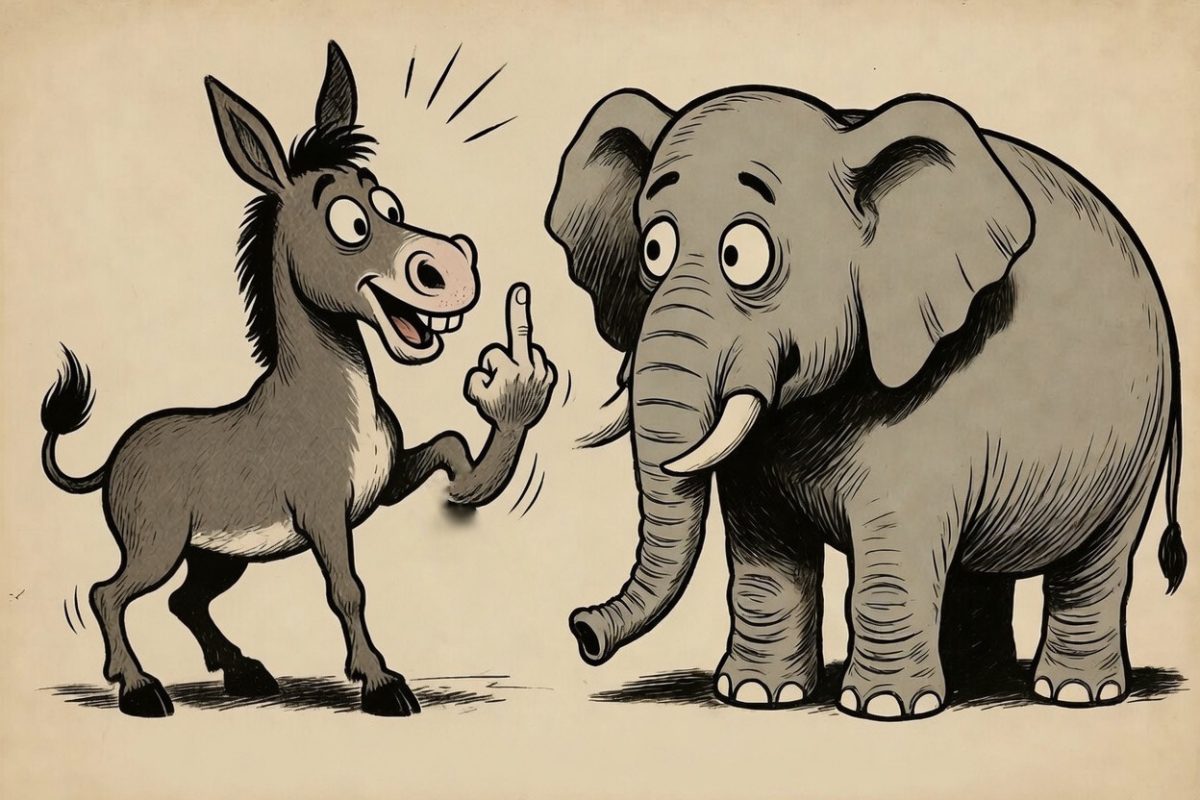
The constant threats thrust by Donald Trump at his own congressional Republicans have, for the most part, kept them in line as they continue to submit to his demands.
But with the midterms fast approaching, a handful of Republicans have tiptoed around resolutions that would allow Trump a free hand such as continuing hostilities against Iran (although as of publication Republicans have once again back-peddled and agreed to Trump’s demands) a “war” the majority of the American public does not favor and one that has benefitted oil companies and certain stockholders.
And Trump has little or no concern for the “disloyal” congressional Republican when after being quoted in a recent press conference, Trump said, “I don’t care about the midterms.”
Still, the GOP’s majority is slim.
With the public’s disapproval of Trump, open dissent from congressional Democrats, and the public regularity of the GOP avoidance of questions regarding Trump’s actual control of his own chamber, the time for an uprising could not be better.
November, is only a few short months away.
The American people need to ask themselves about the very dark direction their country is heading.
Trump’s approval ratings are consistently low, gas prices remain high and out of reach for most working people, polling shows voters think the conflict with Iran is a poor choice and Democrats are leading by varying numbers in surveys of the generic ballot—this, the best indicator for Dems hance to take back control of Congress in the midterms.
Obstacles for voting are being strategically placed all around the country by Trump and through his unconstitutional control of the Department of Justice, Immigration, the FBI and even some local Trump backed law enforcement agencies and state judges.
Trump is clearly afraid of the midterms. And he should be.
In a recent NBC News survey, a majority of respondents said they want “Democrats to win back control of Congress” with less than five months before the midterms.
This same poll conducted from May 29 through June 7 found 49 percent of 2,400 registered voters want Democrats to control Congress after the November elections. Forty-four percent said they want Republicans to maintain control of the legislative branch, while 7 percent of respondents were undecided.
Democrats while narrowly in the minority in the Senate and House, are hoping to flip both chambers of Congress for the first time in two decades.
In order to do so, the party will need to flip four Senate seats held by Republicans. The nonpartisan Cook Political Report rates one of the seats, held by retiring Sen. Thom Tillis (R-N.C.) as leaning in favor of Democratic nominee Roy Cooper, the former governor of North Carolina.
The same report (CPR) meanwhile, rates two races as toss ups: Sen. Susan Collins’s (R-Maine) bid for a sixth term in the upper chamber and Sen. Jon Husted’s (R-Ohio) attempt to get elected to a full term — Ohio Gov. Mike DeWine (R) appointed him to succeed Vice President Vance in 2025.
Democrats are also optimistic about their chances in the Alaska and Texas Senate races, despite the CPR rating both as GOP leans.
With Republicans holding a slim 218-212 majority — and independent Rep. Kevin Kiley (Calif.) caucusing with the GOP — control of the lower chamber is still up for grabs.
According to the Guardian “Republicans right now, in both the House and the Senate, are in freefall,” the House minority leader, Hakeem Jeffries, said on MS Now last month and after Johnson canceled a vote on the Iran war powers resolution.
Still Trump’s threats against lawmakers who defy him continues to have the effect of creating new obstacles in Congress.
“Last year, the North Carolina senator Thom Tillis opted to retire, after drawing Trump’s ire for refusing to support the One Big Beautiful Bill Act, the president’s main domestic policy. He has since become a prominent critic of what he sees as poor choices being made by the Trump’s advisers, and spent months holding up the nomination of Kevin Warsh to lead the Federal Reserve in protest of the justice department’s investigation of then chair Jerome Powell.”
And recently Trump successfully backed primary challenges against the Kentucky congressman Thomas Massie, who championed the release of the Epstein files; the Louisiana senator Bill Cassidy, who voted to convict Trump after the January 6 insurrection; and the Texas senator John Cornyn, who fell out of favor with the Maga movement.
Cassidy, the physician, appeared to try to make amends with Trump by casting a deciding vote to confirm vaccine skeptic Robert F Kennedy Jr as the secretary of health and human services. After losing his primary, he publicly condemned Trump’s bid to create the anti-weaponization fund, then fruitlessly tried to forge a compromise to add language to the immigration enforcement spending bill the Senate passed this week to bar the payouts from ever happening. Cassidy also signed on to a court brief challenging the fund, and voted for an Iran war powers resolution.
Yet, some in the GOP leadership are beginning to see breaking with the president as politically expedient (although they don’t do so publicly) as they face uncertain re-election prospects in November.
And the GOP defectors have done little to curb Trump’s powers or force him to swallow policies against his will.
In other words, Trump still commands lofty threats and uses whatever power he still has over the GOP.
The question becomes, what can stop Donald Trump and hold him accountable to the Constitution and the will of the people?
As the domestic war within our own border wages on, and the current polarization of Americans is something we have never seen before, the question of what needs to be done is coming into clear focus.
The midterms will determine what’s next—either promising, or bleak.
What should America do?
Vote OUT every single Republican in every single office across America.